Learn Cursive Writing: Free Worksheets, Tools & Letter Guides All in One Place
Whether you’re a parent helping your child practice after school, a teacher looking for ready-to-use classroom materials, or someone who wants to finally nail that flowing handwriting style you’ve come to the right place. This site brings together everything you need to learn and teach cursive writing, completely free. From individual letter guides and printable worksheets to online tools and full sentence practice, it’s all here in one place.

What Is Cursive Writing?
Cursive writing is a style of handwriting where the letters within a word are connected in one continuous, flowing motion. Instead of lifting your pen between each letter the way you do in print writing, cursive keeps your hand moving smoothly across the page. This makes writing faster, more natural, and easier on the hand once you get used to it.
Cursive has been taught in schools for generations, and research backs up its benefits. It strengthens fine motor skills, reinforces letter recognition, and builds a stronger connection between the brain and the hand. For many children, learning cursive also improves their reading fluency, since they learn to see words as whole, connected shapes rather than separate letters.
Most children start learning cursive around ages 7 to 9, but there’s no wrong age to begin. Adults who never learned cursive or who want to improve their handwriting can use the same resources here with great results.
Start Here: A Simple Path to Learning Cursive.
Cursive can feel overwhelming at first, especially when you’re not sure where to begin. The good news is that it follows a logical order and when you take it step by step, progress comes quickly. Here’s the path we recommend:
Step 1: Learn Individual Lowercase Letters First.
Lowercase cursive letters are simpler in form and appear far more often in everyday writing. Start by learning each letter in isolation before trying to connect them. Use the individual letter guides on this site each one walks you through stroke direction, common mistakes, and practice tips for both uppercase and lowercase versions.
Step 2: Practice Uppercase Letters.
Once lowercase letters feel comfortable, move on to uppercase. Uppercase cursive letters tend to have more loops and flourishes, so it helps to already have a feel for the basic stroke rhythm before tackling them. Don’t worry about perfection fluency comes through repetition.
Step 3: Join Letters into Cursive Words.
This is where cursive really starts to click. Once you know your letters, you’ll practice how they connect at the baseline. Some connections are smooth and natural; others take a bit of extra practice. The Cursive Words section of this site gives you plenty of examples to follow along with.
Step 4: Practice with Full Cursive Sentences.
Writing full sentences brings everything together punctuation, spacing, and letter connections all in one go. Use the Cursive Sentences section to practice at a comfortable pace. Focus on consistency: letters that are the same height, words that are evenly spaced, and connections that flow without lifting the pen.
Step 5: Build Speed and Fluency with Paragraphs.
The final stage is building stamina and natural speed. The Cursive Paragraphs section gives you longer pieces to copy out, which helps your hand build muscle memory. At this stage, try to write without stopping to check each letter trust the practice you’ve already done and let the flow come naturally.
Cursive Letter Guides: A to Z.
Every letter of the alphabet has its own dedicated guide on this site. Each guide covers:
- How to form both the uppercase and lowercase version
- Step-by-step stroke direction
- Common mistakes beginners make — and how to fix them
- Practice tips and example words
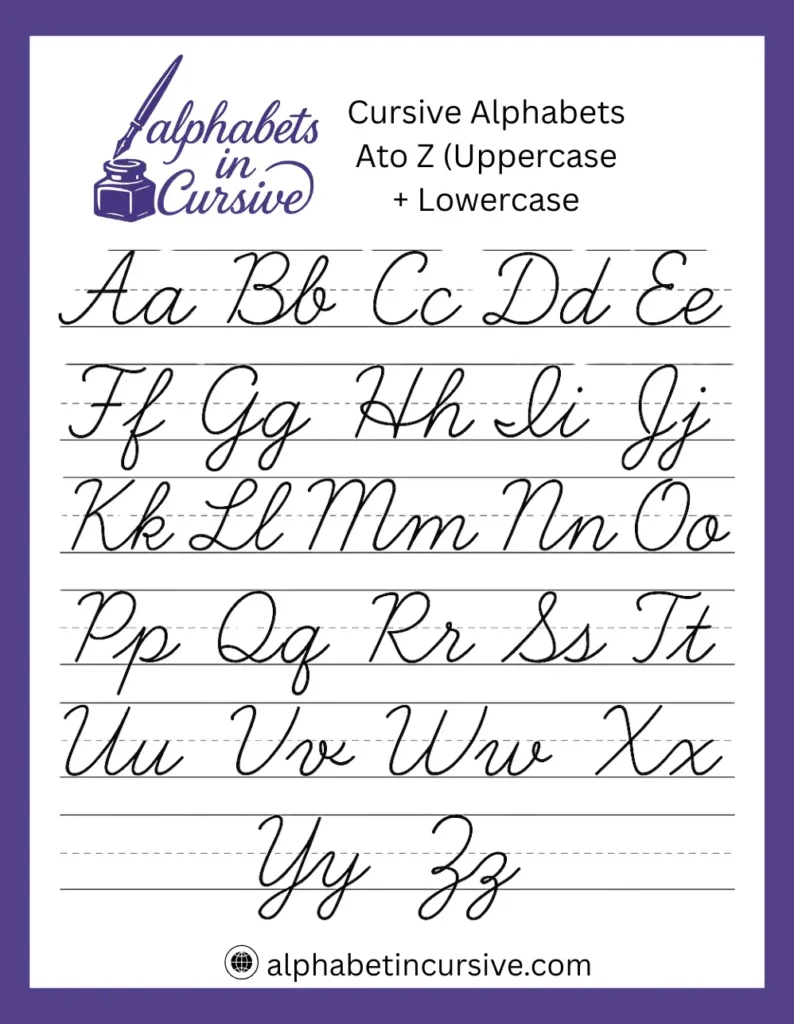
Whether your child is struggling with a tricky letter like cursive ‘f’ or ‘z’, or you want to work through the full alphabet in order, the Cursive Alphabets A to Z dedicated page give you a clear, focused resource for each one. Browse from Cursive A all the way through to Cursive Z using the links in the navigation or the Guides section at the bottom of this page.
Free Printable Cursive Worksheets & PDFs.
Printable worksheets are one of the most effective tools for learning cursive — especially for children, who benefit from the physical act of writing by hand rather than typing. This site offers a dedicated page of free printable cursive PDFs covering individual letters, common words, and full practice sentences. Download them, print them off, and use them as many times as you need. They’re designed to be clean, easy to read, and simple to use at home or in the classroom — no account or payment required.
Free Online Cursive Tools.
Alongside the written guides and worksheets, this site has two free online tools that parents and teachers find especially useful:
Cursive Text Generator
Type any word, name, or sentence into the Cursive Text Generator and instantly see how it looks written in cursive. This is perfect for visual learners who want to see the finished result before they try writing it themselves. Teachers can use it to create example text for classroom displays, and parents can use it to show kids what their name or favourite words look like in cursive.
Cursive Worksheet Generator
The Cursive Worksheet Generator lets you type in any word or sentence and instantly produce a printable practice sheet. Instead of using generic worksheets, you can create practice sheets using your child’s name, spelling words from school, or any text that’s relevant and motivating for them. It takes about 30 seconds and produces a clean, print-ready page.
All Cursive Resources at a Glance
Here’s a quick overview of everything available on this site so you can jump straight to what you need:
- Cursive Alphabets — Uppercase and lowercase reference sheets for every letter
- Cursive Words — Commonly used words shown in cursive, great for tracing and copy practice
- Joining Letters — Focused practice on connecting letters smoothly without awkward lifts or gaps
- Cursive Sentences — Full sentence practice covering punctuation, spacing, and flow
- Cursive Paragraphs — Longer writing exercises to build speed, endurance, and natural rhythm
- Cursive Writing Worksheets — Structured printable sheets for letter formation and daily practice
Who This Site Is For.
Parents Teaching at Home
If your child’s school doesn’t teach cursive or doesn’t teach it in a way that’s really sticking it’s easy to fill that gap at home with the right resources. You don’t need a teaching background. The letter guides on this site are written in plain language, the worksheets are ready to print, and the tools make it easy to personalise practice around words your child actually cares about. Even 10 to 15 minutes a few times a week makes a noticeable difference over time.
Classroom Teachers
Planning handwriting lessons takes time and finding materials that are actually at the right level for your students takes even longer. The resources here are organized by skill level, from individual letter formation all the way through to paragraph writing. You can print worksheets in batches, use the worksheet generator to create custom practice sheets for specific students, and direct learners to the letter guides for independent practice. Everything is free to use in classroom settings.
Homeschoolers
Handwriting is a core part of many homeschool curriculums, and cursive in particular tends to be something homeschool families take seriously. This site gives you a structured, sequential resource you can work through at your own pace. There’s no fixed timeline — move as fast or as slowly as your child needs, and use the full range of resources (guides, worksheets, generators, sentence and paragraph practice) to build a well-rounded handwriting routine.
Practical Tips for Teaching Cursive to Kids (That Actually Work)
If you’ve tried teaching cursive before and it hasn’t gone smoothly, you’re not alone. Here are some approaches that make a genuine difference:
Teach Letters in Stroke Families, Not Alphabetical Order
Rather than starting at ‘a’ and working straight through to ‘z’, group letters by how they’re formed. Letters like c, a, d, g, and o all begin with the same anticlockwise curve. Teaching them together means children only need to learn one core motion — and they pick up four or five letters at once instead of one. It’s a small change that makes learning feel much more manageable.
Keep Practice Sessions Short
Ten focused minutes is genuinely more effective than forty minutes of half-hearted practice. Children’s attention and fine motor stamina both have limits — and pushing past them leads to sloppy writing and frustration. Aim for short, consistent sessions rather than long, infrequent ones. Daily practice of even 10 minutes produces results you’ll see within a few weeks.
Use Meaningful Words for Practice
Children engage far more with practice when they’re writing something that means something to them — their own name, a friend’s name, a favourite animal or book character. Use the Worksheet Generator to create personalised sheets in seconds. The content doesn’t change how the letters are formed, but it does change how motivated a child is to write them.
Praise Effort and Consistency, Not Just Neatness
It’s tempting to focus on how the letters look, but at early stages, the most important thing is that a child is willing to keep trying. Notice when their letters improve — even slightly — and point it out specifically. ‘That loop on your ‘l’ is so much smoother than yesterday’ lands better than a general ‘good job’ and gives them something concrete to feel proud of.
Don’t Skip the Joining Practice
Many children learn individual letters well but then struggle when they try to connect them. Letter joining has its own logic some letters connect at the bottom, others at the midline and it’s worth spending dedicated time on this before moving to full words. The Joining Letters section of this site breaks this down clearly and gives you targeted practice for the most common tricky combinations.
Frequently Asked Questions About Cursive Writing
At what age should children start learning cursive?
Most children are ready to start cursive between ages 7 and 9, once they’ve developed enough fine motor control and are comfortable writing in print. That said, some children are ready a little earlier, and some benefit from waiting until their print handwriting is more settled. There’s no universal ‘right’ age — readiness matters more than age.
Is cursive still taught in schools?
It varies widely depending on where you are. In some countries and school districts, cursive is still part of the standard curriculum. In others — particularly in the US — many schools dropped formal cursive instruction in favour of keyboard skills. This is one of the reasons parents and homeschoolers often look for outside resources to fill the gap.
How long does it take to learn cursive?
With regular short practice sessions, most children can learn to write all 26 letters in cursive within 2 to 3 months. Writing fluently — where the letters connect smoothly without having to think about each one — typically takes a few more months of consistent practice. Adults who are learning from scratch often progress faster because of stronger fine motor control.
What is the easiest cursive style for beginners?
D’Nealian and Zaner-Bloser are the two most beginner-friendly styles. D’Nealian is particularly popular for young learners because its letter shapes are close to standard print, making the transition from print to cursive much smoother. Zaner-Bloser uses slightly more upright, round forms that are easy to read and simple to teach. Both are great starting points.
Do I need special paper to practice cursive?
Standard wide-ruled or college-ruled lined paper works well for most learners. For younger children just starting out, you can use paper with a midline — a dotted line in the middle of each row — which helps them keep the height of their letters consistent. Some of the printable worksheets on this site already include this guideline.
Can adults learn cursive writing?
Absolutely. Adults actually have a few advantages over young learners — stronger fine motor skills, better ability to follow written instructions, and more patience for repetitive practice. All of the resources on this site work just as well for adults as they do for children. Start with the letter guides, pick up the printable worksheets, and give yourself the same short, consistent practice sessions you’d recommend to a child.
Where to Start
If you’re just getting started, the best place to begin is the Cursive Alphabets section, which gives you a clear overview of every letter in both uppercase and lowercase. From there, work through the individual letter guides at whatever pace works for you, use the printable worksheets to get in your daily practice, and reach for the tools whenever you want something a bit more interactive. Everything here is free, and everything is designed to make learning cursive simple, structured, and genuinely useful.